How to screen 50 applicants in one afternoon without lowering the bar
Fifty applicants, one afternoon, eight to meet by half past four. An hour-by-hour plan built on a six-minute one-way video interview, with the arithmetic and the rules that stop speed lowering the bar.
Fifty applications for one role sounds like a good problem until you're the person who has to read them. Phone screening all fifty is out of the question: at half an hour each that's 25 hours of calls before you've arranged a single one. So most teams skim the CVs, call the ten that stand out and hope the right people were in that ten. The trouble is that "stands out" on paper often means "worked somewhere I've heard of", and that's how good candidates slip through. You can screen applicants fast without that trade-off, but not by phone.
The way to do it doesn't need a bigger team. It needs some preparation the week before, a short one-way video interview, and one clear afternoon. By half past four you have eight people to meet, everyone else has heard from you, and all fifty have been judged against the same standard.
This post is that afternoon as a timed schedule, with the arithmetic. It assumes you know roughly what a one-way video interview is; if not, start with that playbook.
Before the afternoon: three things to set up
The afternoon only works because the recordings are already waiting for you. That means doing three things about a week earlier.
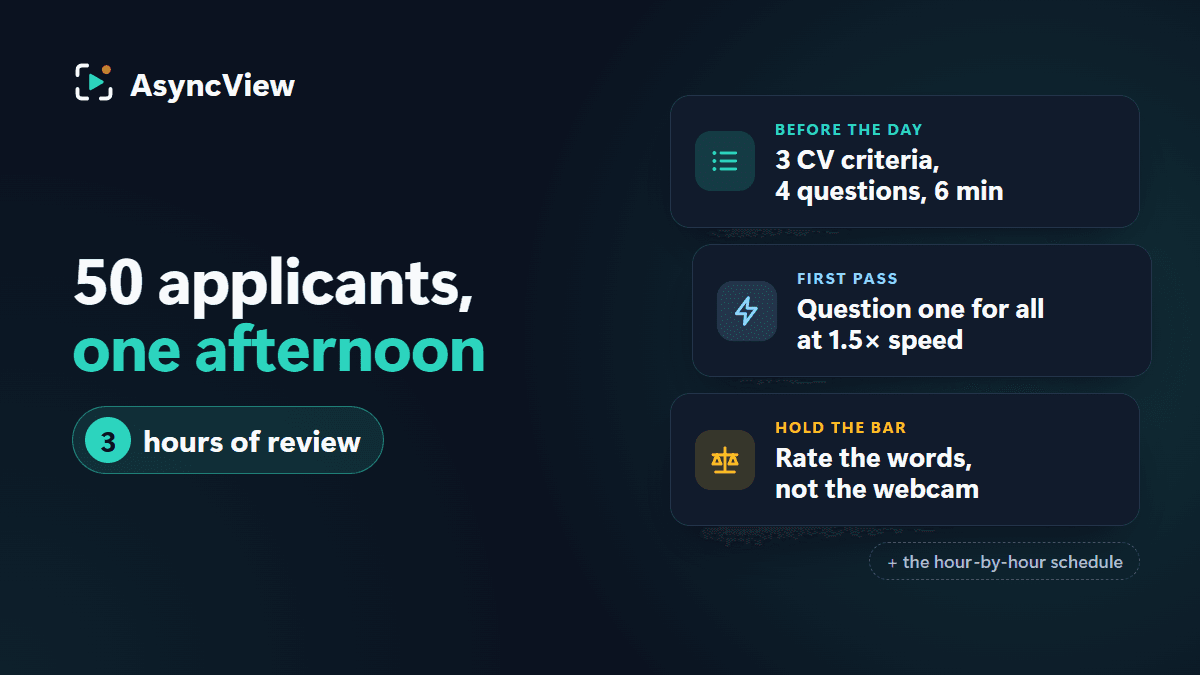
1. A CV pass with three hard criteria
Write down the three things an application must show before it's worth a video. Not "good communicator", which you can't see on a CV. Things you can check in ten seconds: the right to work in the country, two years in a comparable role, availability for the shift pattern. If it isn't on the CV, it's a no.
With the criteria written down, 50 CVs take about 15 minutes, because you're checking them rather than reading them. Expect roughly 30 to 35 of the 50 to pass.
2. A four-question interview of about six minutes
Four questions, each with its own time limit, adding up to around six minutes of recording. For a junior account manager role, say:
What made you apply for this role rather than the others you're looking at? (1 minute)
Tell us about a client relationship you rescued, and how you went about it. (2 minutes)
A client emails to say they're cancelling at the end of the month. Talk us through your first reply. (2 minutes)
How do you decide what to do first on a busy morning? (1 minute)
Put the question that tells you most in the first slot. If you need ideas, there's a question bank sorted by what each question reveals. Keep the four as a question set and importing them for the next role takes seconds.
3. An invitation sent a week ahead, with the deadline in it
Send the invites on a Monday with a deadline of the following Sunday evening. Put the deadline, the number of questions and how long it'll take in the email itself. AsyncView emails each candidate a reminder at 48 hours and another at 24, which saves you chasing. Then block out the following Monday afternoon for you and a colleague. If someone has pleaded for more time, give their deadline another week.
The afternoon, hour by hour
Say 32 candidates passed the CV check and 28 recorded answers. Those are example numbers; your completion rate will vary. Here's the schedule.
1:00 — Write the "strong answer" line for each question
Fifteen minutes, before you press play. For each question, write a single line on what a strong answer does. For the cancelling client it might be: asks why before arguing, doesn't promise what they can't deliver, and suggests a call rather than fighting by email. This sentence holds the bar in place for the next three hours.
1:15 — First pass: question one, every candidate, at 1.5×
Watch only the first question, for all 28 candidates, and score each answer out of five stars with a one-line note. At 1.5× a one-minute answer takes 40 seconds, so with the scoring it's about a minute and a quarter per candidate. Twenty-eight candidates is around 35 minutes.
Rating one question across everyone, rather than one candidate from start to finish, is the biggest change most people make to how they review. Two reasons:
Consistency. When you've just heard twelve answers to the same question, you know exactly what four stars sounds like and what two stars sounds like. Switch between questions and that calibration goes.
You spot the pattern. After ten answers you notice that the strong ones all mention something specific about your company, and the weak ones could have been recorded for any job.
In AsyncView the J and K keys hop between questions and playback goes up to 2×. Anyone on one or two stars for question one is probably out. Don't reject them yet; note it and move on. Expect to carry 15 to 18 people into the second pass.
2:15 — Questions two to four, for the candidates still in play
Same method, one question at a time, across the remaining candidates. Say 16 are left and the other three questions total five minutes of recording. At 1.5× speed that comes to about three and a half minutes each, call it four with notes, so 16 candidates is just over an hour. Rate each answer against its strong-answer line, then give an overall call, from Strong yes down to No.
If you fall behind, drop question four for anyone who already has two weak answers.
3:30 — Compare with your colleague's ratings
Your colleague has done the same thing in parallel, without seeing your scores. In AsyncView each reviewer's stars, call and notes appear next to each other (the review screen is pictured on the features page), so this part is quick. Where you agree there's nothing to discuss. Spend the half hour on the five or six where you don't, and argue about the answer, not the person: "I gave the cancellation reply two stars because she went straight to a discount." That conversation is where the bar is actually held.
4:00 — Shortlist eight, tell everyone else
Pick the eight you want to meet. Eight from 50 is roughly one in six, enough for a live round with real choice. Shortlist them in the app and send the live-round invitations.
Then the part teams put off: the 20 people who recorded answers and aren't going further. Send a short, kind message today, not next week. Something like: thanks for recording your answers. We watched them all, and we've decided to go forward with candidates whose experience is a closer match. We'd be glad to see you apply again. Rejecting is final in AsyncView, so check the name before you click. The 18 whose CVs didn't pass should have had a short no the week before, and the four who never recorded get a one-line note too.
The arithmetic
As a worked example, here's where the afternoon goes:
Strong-answer lines: 15 minutes
First pass, 28 × question one: about 35 minutes
Second pass, 16 × three questions: about 65 minutes
Comparing with a colleague: 30 minutes
Shortlisting and messages: 30 minutes
Call it three hours of your time and two of your colleague's, plus the 15-minute CV pass and 20 minutes setting up the interview the week before. The same 50 applicants through 30-minute phone screens, even if you only called the 28, is 14 hours of calls stretched over a fortnight of diary juggling. More on that comparison in reducing time-to-hire.
The rules that keep the bar high when you screen applicants fast
Speed is only a virtue if the eight you shortlist are the right eight. Four rules:
Same questions, same limits, for everyone. No bonus question for the candidate you liked on paper.
Judge the answer, not the webcam. A bedroom background, a grainy picture and an accent you had to concentrate on are not the job. Your strong-answer line mentions none of those, so your rating shouldn't either. There's more on this in bias in one-way interviews.
Write a note a colleague could use. "Good" is not a note. "Named our two biggest competitors and said why she'd pick us, 0:20" is.
Don't skip the no's. Candidates who gave you six minutes get a reply. Twenty minutes with a saved message, and it's the difference between people who reapply and people who warn their friends off.
When it's 200 applicants, not 50
High-volume screening at that level follows the same plan, with three changes.
Tighter CV criteria. Criteria that pass two in three of 50 applicants will pass about 130 of 200, which is too many to watch. Add a fourth criterion, or make one stricter, until you're inviting 60 to 80 people to record.
Two reviewers split the first pass. Each takes half the candidates for question one, both working from the same strong-answer line. Swap a few borderline candidates between you to check your calibration matches. Then both of you rate everyone who survives.
A longer deadline. Ten days instead of seven. More people recording means more who need the extra time, and the pipeline bar shows who's finished, who's partway through and who hasn't started.
Reckon on two afternoons rather than one, and a shortlist of ten to twelve. The method to screen applicants fast is the same; only the numbers change.
Where speed stops being a good idea
First, fast for you shouldn't mean fast for candidates. A 24-hour deadline to record a video interview isn't a screening method, it's a filter for people who happened to be free that evening. A week is the shortest deadline we'd suggest, and this whole plan depends on it: the recordings wait for you, rather than you waiting for them.
Second, some roles deserve a slower look. If you have twelve applicants for a senior role, don't squeeze them into a three-hour sprint. Watch everything, at normal speed, over a couple of days. The point of learning to screen applicants fast is to have that time when it matters. And if someone asks to do the interview another way, for any reason, say yes.
Frequently asked questions
Realistically, how many candidates can one person review in an hour?
Around 40 if you're watching a one-minute first question at 1.5× and rating as you go; around 12 if you're watching a full six-minute interview per candidate. That gap is why the first pass looks at one question only.
How long does it take to screen 50 applicants?
With a one-way video interview and the schedule above, about three hours of one person's time in a single afternoon, plus a 15-minute CV pass the week before.
Should I watch every answer from every candidate?
No. Watch question one from everyone, then the rest from the people whose first answer kept them in play. Everyone gets the same first judgement.
How many should I shortlist from 50 applicants?
Six to eight for a live round is usual. Fewer than five and one dropout leaves you thin; more than ten and the live round becomes a second screening.
What if too few candidates complete the interview?
Check the deadline first: under a week, completion drops. Check the invitation says how long it'll take and why you want video. Then extend by seven days for anyone who started but didn't finish, and invite the next few CVs down your list.
The quickest way to trust this plan is to run it on a role you've already screened the slow way. Set up the four questions, invite yourself before anyone else, and notice how long your own answers take. Then time your next afternoon.