One-way vs live video interviews: which to use for each hiring round
It's a sequence, not a contest. Six plain comparisons, a round-by-round recommendation, and how to hand over from a recorded round to a live one.
Somewhere in most hiring plans there's a line that says "first-round interview" and nobody has decided what that means. A 30-minute call with the recruiter? A recorded set of questions? Both? The one-way vs live video interviews question usually gets settled by habit, and habit picks the phone screen, because that's what we did last time.
It's worth settling properly, because one-way vs live video interviews aren't competing for the same slot. A one-way video interview is good at the early, wide part of the process. A live interview is good at the late, narrow part. Most teams that run one well run both.
Two formats, briefly
In a one-way video interview, you set a handful of questions and a closing date; each candidate films their replies on their own schedule, with nobody watching live, and your team reviews the footage once it's in. You'll also hear it called an async interview or a recorded interview.
A live video interview is a conversation over a video call, at a time that suits both sides, with at least one of your team on the line.
That's the whole difference: whether anyone is listening while the candidate speaks.
One-way vs live video interviews: six points of comparison
1. Scheduling and time cost
Live calls have to be booked. Each one needs a slot that suits a candidate with a job and an interviewer with a diary, plus the emails to find it and the reschedule when something comes up. One-way interviews skip all of that: you send each candidate a link, set a closing date, and they record whenever their evening or lunch break allows.
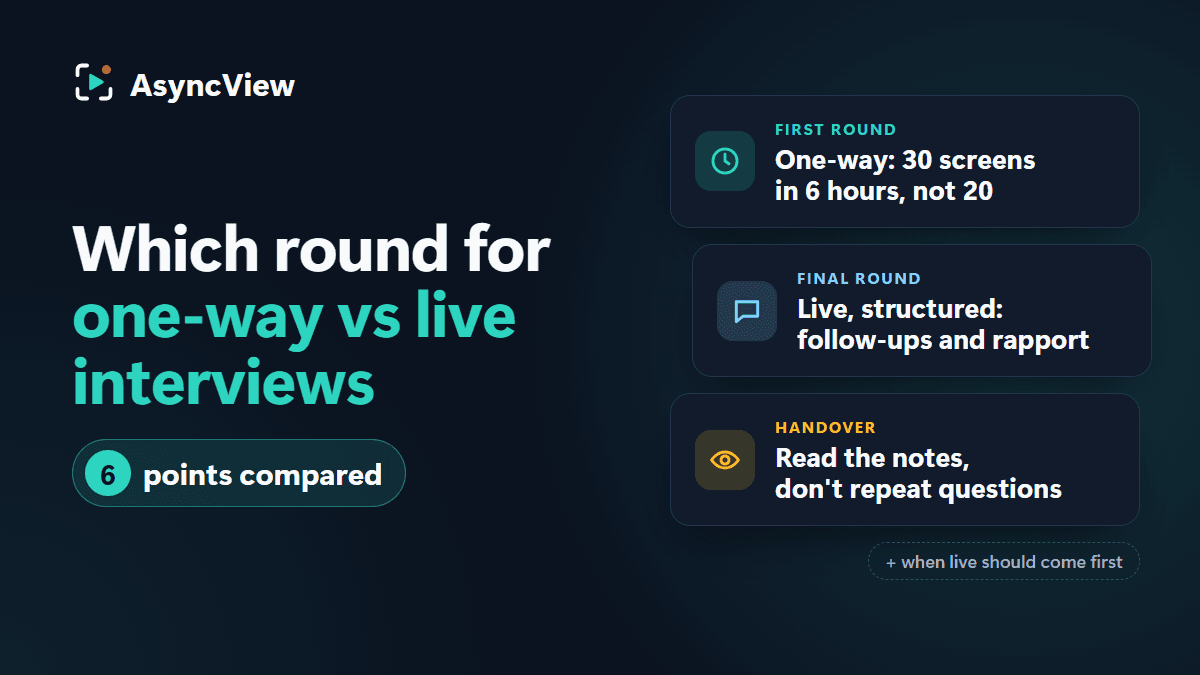
A worked example, for illustration only. Say 30 applicants reach the first round. Live screens at 30 minutes each, with another 10 minutes per candidate for diary juggling and notes, come to about 20 hours of one person's time, spread over two or three weeks. One-way interviews for the same 30 people, reviewed at 12 minutes each, come to about 6 hours, in two sittings. Your numbers will differ, but the shape won't.
Verdict: one-way, by a wide margin, whenever you're screening more than a handful of people.
2. What you can actually assess
A one-way interview tells you how someone communicates, whether they've thought about why they want this job, and how they reason through a set question when they can't ask you to clarify. For a screening round, that's most of what you need. It's also where it stops. You can't follow a thread, push back on a thin answer or ask "what happened next?"
A live interview is built for exactly those things: follow-up questions, depth on a specific project, how the candidate handles disagreement, salary and start-date conversations, and the plain human sense of whether you'd want to work together. None of that survives being recorded alone in a spare room.
Verdict: one-way for breadth, live for depth. Neither does the other's job well.
3. Consistency and fairness
A one-way interview hands each candidate an identical experience: identical questions, identical time limit, identical number of takes (in AsyncView, one). Each reviewer gives their own scores, and if everyone rates before reading colleagues' notes, nobody's first impression sways the rest. It's hard to be more consistent than that.
Live interviews drift. The first candidate of the day gets a sharper interviewer than the sixth. One person gets a follow-up the next doesn't. Then the interviewer writes "good energy" in a notes field and that becomes the record.
The honest point, though: the problem isn't that the interview was live, it's that it was unstructured. A structured live interview, with a fixed set of questions, a scoring guide agreed in advance and ratings written down before any discussion, is far better than a free-flowing chat, and not far behind one-way on consistency. If your live interviews feel random, fix the structure before you blame the format.
Verdict: one-way is consistent by default; live can be consistent if you make it so. Unstructured live is the worst of the three.
4. Candidate experience
This one is genuinely mixed. Some candidates prefer one-way: they can record late in the evening once the house is quiet, nobody at their current job sees them slip out for a mysterious "appointment", and the practice question beforehand takes the edge off. Others find talking to a camera strange, would rather have a person nodding back, and want to ask their own questions early.
What helps either way: tell candidates why you've chosen the format, roughly how many minutes they'll need, and when they'll hear back. A short, warm invitation does more for the experience than the choice of format. Our tips for candidates shows the other side of the table.
Verdict: a draw. One-way wins on flexibility, live wins on rapport, and a clear invitation matters more than either.
5. What you keep afterwards
After a live interview you have one person's notes, written from memory. If the hiring manager wants a second opinion, they get a second-hand account.
After a one-way interview you have the recording. Anyone on the team can watch it, at 1.5× if they're in a hurry, and form their own view. When two reviewers disagree, you can both go back to the exact answer instead of arguing about what someone "basically said".
Verdict: one-way. A recording the whole team can see beats one person's notes.
6. Cost in people's hours
A live interview costs the interviewer the full slot, whoever the candidate is. A weak candidate and a strong one both take 30 minutes. A one-way interview costs only the time you choose to spend: a clearly unsuitable answer can be rated in three minutes, a strong one gets a careful watch.
A hiring manager who screens 30 candidates live loses two working days. If they instead watch the 8 the recruiter shortlisted from recordings, they spend a couple of hours, on better conversations. There's more in how one-way video interviews cut hiring costs.
Verdict: one-way for volume, live for the few people who've earned the hours.
Which format for which round
Put together, the one-way vs live video interviews comparison points in one direction: use the formats in sequence, not instead of each other.
First round: one-way. Three to five questions, a week's deadline, the whole team rating independently. This replaces the phone screen: you're finding the handful worth a real conversation, and a recording is the cheapest fair way to do it.
Second round: often one-way again, with fewer, deeper questions. Two or three questions, longer time limits, and a scenario specific to the job. "Here's a real situation we had last quarter; what would you have done?" with three minutes to answer tells a hiring manager a lot, and still doesn't need a diary slot. If the first round left you with six strong people, skip this and go straight to live.
Final round: live, always. This is where follow-ups happen, where the candidate interviews you back, and where you settle the practical questions. Make it structured: same core questions for everyone, written ratings before the debrief.
When live should come first
Senior and specialist hires. A head of engineering or a tax specialist expects a human on the other end from the start, and you'll learn more from twenty minutes of conversation than from any recording. A recorded first round can read as a lack of interest.
Very small candidate pools. If four people applied, the scheduling saving is small and the goodwill cost isn't worth it. Just call them.
When a candidate asks. If someone requests a live alternative, whether for accessibility reasons or simply preference, give them one without fuss and without marking them down for it.
Building your first one-way round? Our guide to your first one-way interview has the questions, time limits and invitation covered.
Handing over from one-way to live
The sequence only works if the live round builds on the recorded one rather than starting again.
The live interviewer reads the notes first. Before the call, they watch the recording, or at least read the team's ratings and notes. In AsyncView each reviewer's ratings and notes appear in one view, and the catch-up takes two minutes.
Don't repeat the recorded questions. Nothing deflates a candidate faster than "so, tell me why you applied" when they already answered that on video. It also wastes the one thing a live call is for.
Use the hour for follow-ups. "In your second answer you mentioned moving a customer to a different plan. How did that conversation actually go?" That's a question a recording can't ask, and it's where the live round earns its slot.
Our tips for recruiters has more on running the live side well.
What neither format fixes
It's tempting to think settling one-way vs live video interviews will fix a slow or muddled process. It won't. If the role is vague, candidates give vague answers on camera and in person, and your team disagrees about what "good" looked like because nobody wrote it down. If decisions take three weeks after the final round, the best candidates have gone elsewhere, whether the first round took six hours or twenty.
A one-way interview saves time at the top of the funnel. A structured live interview gives depth at the bottom. Neither tells you what you're looking for, and neither makes a committee decide.
Frequently asked questions
Is a one-way interview better than a live interview?
Neither is better in general. A one-way video interview vs live interview isn't a fair fight because they do different jobs: one-way is better for screening many candidates fairly and quickly, live is better for depth, follow-up and getting to know a finalist. Use one-way early and live late.
Do candidates prefer live or one-way interviews?
It varies. Some like being able to record at any hour and skip the scheduling dance; others would rather talk to a human and ask questions back. A clear invitation that explains the format, the expected duration and the next step matters more than the format itself.
Can a one-way interview replace a live interview?
It can replace the phone screen and often a second screening round. It shouldn't replace the final interview, where you need follow-up questions, a two-way conversation and the practical details that lead to an offer.
What's the difference between a one-way interview and a video call?
A video call is live: both sides are present and respond to each other. A one-way interview is recorded: the candidate answers fixed questions by themselves ahead of a closing date, and the team reviews them afterwards. The questions and time limits are the same for everyone.
Should senior roles use one-way interviews?
Usually not as a first round. Senior and specialist candidates expect an early conversation, and the pool is often small enough that scheduling isn't a problem. A short recorded round can still work later, for a specific task or scenario, if you explain why you're asking.
Not sure whether a recorded first round would suit your team? Put yourself through one: create three questions in AsyncView, invite your own email address and answer them. Fifteen minutes in the candidate's chair will settle whether it belongs in your process, and how it works shows that side with screenshots.