How one-way video interviews cut hiring costs (with a simple calculation you can copy)
Where cost per hire actually goes, a worked calculation for one role with 30 candidates (phone screens vs one-way video, every assumption stated), five places the saving quietly disappears, and how to measure your own number in 15 minutes.
Ask a founder what a hire costs and the answer is a shrug and a guess. Ask a finance lead and the answer is a figure that misses the dearest line of all: the hours your own people spent on it. To reduce hiring costs, start there, because you can't cut what you haven't counted.
This post is numbers, not adjectives: where cost per hire actually goes, then one role with 30 screened candidates worked through two ways, with phone screens and with one-way video interviews. Every assumption is written down so you can swap in your own rates. Then the uncomfortable part: five ways the saving disappears, and how to measure your own cost per hire before your coffee goes cold.
New to the format? In a one-way video interview, candidates answer your questions on camera, alone, at a time of their choosing before a deadline. The recordings then wait for your team to watch when it suits you. The benefits post covers the why. This one covers the money.
Where cost per hire actually goes
Most of the cost of a hire never shows up on an invoice. Here's the full list, roughly in order of how often it gets forgotten.
Your people's hours. A recruiter or coordinator screening, scheduling and chasing. A hiring manager interviewing. Two or three colleagues on a panel. All paid, all pulled off other work.
The empty seat. Every week a role stays open, the work either doesn't get done, gets done slowly by someone else, or gets done by a contractor at a premium. This is often the largest cost and almost never counted.
Agency fees. A percentage of first-year salary if you use one. Easy to count, which is why it's the only number some teams track.
No-shows and reschedules. A 30-minute slot that nobody turns up to still cost 30 minutes, plus the emails before and after.
Travel and on-site rounds. Train fares, lunches, a meeting room for an afternoon and four people's diaries cleared.
The bad hire. When a decision gets rushed because everyone's tired of the process, the bill arrives months later: lost output, a second search, and the team's patience.
Video interviews only touch some of these. They do nothing about the agency fee. But they act on the two biggest items, people's hours and the empty seat, which is where the calculation starts.
How one-way video interviews reduce hiring costs: a worked example
One role. Thirty applicants worth screening. The question is what it costs to get from those 30 to the four or five people your hiring manager should actually meet.
The assumptions (swap in your own rates)
Recruiter or coordinator: $40 an hour, fully loaded.
Hiring manager: $75 an hour, fully loaded.
Phone screen: a 20-minute call plus 10 minutes of scheduling, notes and chasing per candidate.
One-way review: about 8 minutes per candidate, which is three or four short answers at 1.25× plus a rating and a line of notes.
Manager interview: one hour per candidate, including prep and write-up.
Empty seat: $500 a week in lost output or cover. Deliberately modest. Yours is probably higher.
These are example figures, not benchmarks. A senior engineer's empty seat costs more than a part-time admin's, and rates vary by city. Put your own numbers in and the arithmetic still holds.
Route A: phone screens
You call everyone. A 20-minute call only tells you so much, so eight candidates sound promising enough to pass on to the manager.
Recruiter: 30 candidates × 30 minutes = 15 hours, or $600
Manager: 8 interviews × 1 hour = 8 hours, or $600
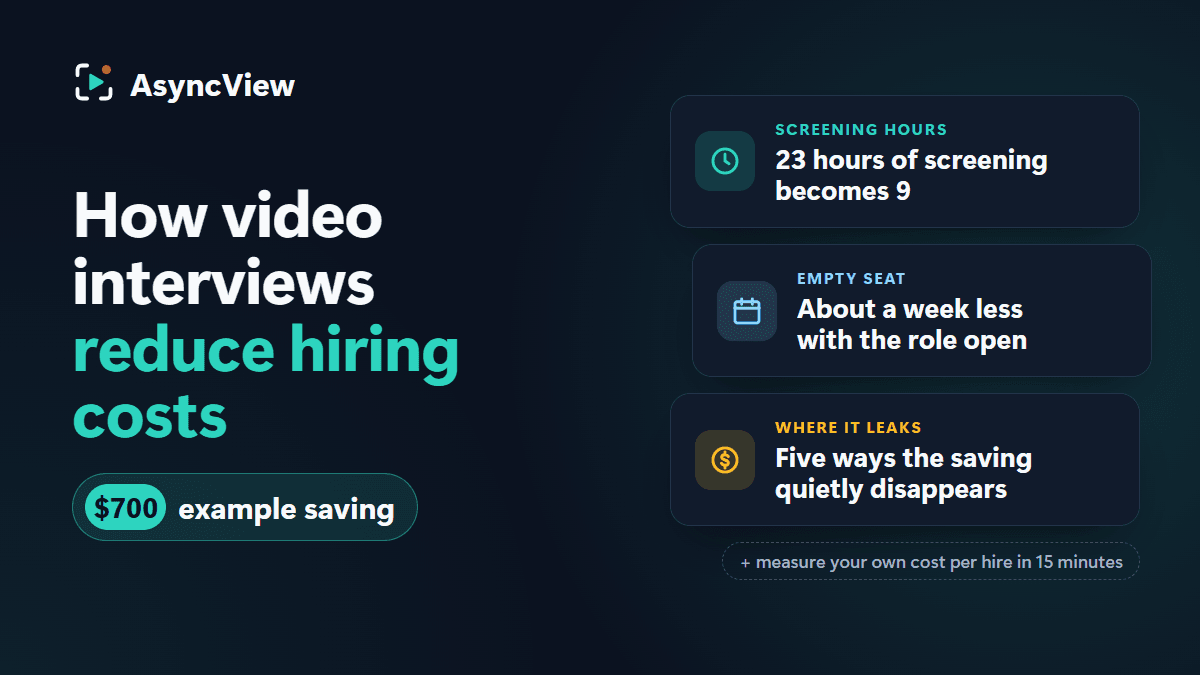
Total: 23 hours, $1,200
Route B: one-way video interviews
You send everyone the same four questions. The recruiter watches and rates every answer, then shortlists four people for the manager to meet. Those four are also better picks, because everyone answered the same questions rather than whoever happened to be chatty at 4pm on a Tuesday.
Recruiter: 30 candidates × 8 minutes = 4 hours, plus 1 hour to write the questions and send the invites, so 5 hours, or $200
Manager: 4 interviews × 1 hour = 4 hours, or $300
Total: 9 hours, $500
The difference
Hours saved: 23 − 9 = 14 hours per role
Money saved: $1,200 − $500 = $700 per role
That's how one-way video interviews reduce hiring costs in practice: not by making anyone work faster, but by spending the expensive hours on fewer, better-chosen people. Hire ten times a year on those numbers and it's 140 hours and $7,000 back. Run the same role again and the saved question set removes the set-up hour too.
The extra saving: fewer days with an empty seat
Thirty phone screens don't happen in a day. They happen in 20-minute gaps between other meetings, so screening 30 people usually takes about two weeks of calendar time, with reschedules on top. A one-way interview goes out to all 30 at once with a seven-day deadline. AsyncView sends reminder emails 48 and 24 hours before the link closes, and the recruiter watches everything in a couple of sittings at the end. Call it a week saved.
Empty seat: 1 week × $500 = $500
Combined saving for the role: $700 + $500 = about $1,200
If your empty-seat number is nearer $2,000 a week, which it is for anyone who bills clients, the calendar saving quickly outgrows the hours saving. The time-to-hire post goes into where those days come from.
Five places the saving quietly disappears
The arithmetic above assumes you run the interview well. Here's how teams who set out to reduce hiring costs lose the $700 without noticing.
Too many questions, so fewer people finish. Ten questions at two minutes each is a 20-minute exam. Good candidates with other options simply don't do it, and you're back to a smaller pool. Three to five questions, under 12 minutes of recording, keeps completion up.
Reviewers don't rate independently, so you still need a meeting. If three people watch the same answers and then hold a 45-minute call to decide, you've spent more manager time than a phone screen would have. The fix is for everyone to score the answers before they talk, then spend the meeting only on candidates where the scores split. In AsyncView, each person's stars, recommendation and notes line up next to one another, so the disagreements are visible without a call.
Slow replies, so good candidates leave. Recordings that sit unwatched for a fortnight cost you the people you most wanted. Review within a few days of the deadline and reply to everyone, including the no's.
Paying for features you don't use. Some tools bundle AI scoring and a long list of add-ons into a per-seat price, and a small team pays for all of it to use a third of it. AsyncView deliberately doesn't do AI scoring; your team watches and rates the answers. The post on choosing a tool has a checklist for working out what you'd actually use.
Letting the video round become the only round. Skipping the live conversation to save another hour is how the bad-hire cost from the first list comes back. The video round replaces the phone screen, not the conversation with the manager.
How to measure your own cost per hire in 15 minutes
You don't need a model. You need the last role you filled and a notepad.
Count the people's hours. Who touched the hire, and roughly how long for? Screening calls, interviews, panel time, scheduling, writing the ad, debriefs. Round to the nearest hour.
Multiply by a loaded rate. Salary divided by about 2,000 working hours, plus 20 to 30 per cent for overheads as a rough rule of thumb. If that feels like too much effort, use one blended rate for everyone.
Count the days the seat was empty. From the day the last person left (or the role was approved) to the new person's first day. Put a weekly value on it, even a rough one.
Add the invoices. Job board, agency, assessments, travel, any software.
Add it all up. That's your cost per hire for that role. Do the same for your next hire with a one-way video round in place of phone screens, and you'll have your own version of the calculation above instead of ours.
Keep the notepad. Three or four hires in, you'll see which line moves and which doesn't.
Honest limits
One-way video interviews reduce hiring costs at one stage: screening. They don't cut sourcing costs. If the expensive part of your process is finding candidates in the first place, through agencies or paid ads, a cheaper screen won't change that bill.
The biggest cost on the list is still a bad hire, and no screening format prevents that on its own. What a one-way round gives you is more evidence, compared more fairly, before the manager's time goes in. Use it to decide better, not just faster.
Some roles shouldn't start with a recorded answer at all: senior hires who expect a conversation, candidates who ask for an alternative, or a role with three applicants where a phone call is honestly quicker. Our guide to running a one-way interview has a section on the roles where you should pick up the phone.
On price: AsyncView is free, with usage limits shown in the app. For a small team hiring a few times a year, the software line in your calculation can be zero. You can see what's included on the features page.
Frequently asked questions
How much does a bad hire cost?
There's no reliable universal number, and the ones you'll see quoted are mostly guesses dressed up. For your own business, add the months of salary paid, the output you didn't get and the cost of running the search again. It's usually several times the cost of the hiring process itself.
What is a good cost per hire?
Lower than your last one, measured the same way. Industry averages vary so much by role, location and seniority that they're not much use as a target. Track your own number per role and aim to move it.
Do video interviews really save money for small companies?
Yes, because small companies pay the hidden costs most heavily: the founder is the recruiter, the hiring manager and the panel. Fourteen hours back per role matters more when there are six of you than when there are six hundred.
Is one-way interview software expensive?
It ranges from free to several thousand dollars a year, usually depending on seats and features. AsyncView is free with usage limits. Price any tool against the hours it saves you, not against other tools.
What costs don't video interviews reduce?
Sourcing: job boards, agency fees, advertising. Final-round costs: the live interviews and on-site visits you should still do. And they don't reduce the cost of a bad decision if you rush the rounds that follow.
The quickest way to check the arithmetic is to be your own first candidate. Create an interview in AsyncView with four questions, invite yourself, record the answers, then time how long it takes you to review them. Put that figure into the calculation above in place of our eight minutes. If you'd rather see both sides first, start with how it works.