How to reduce time-to-hire with one-way video interviews
Most of a 30-day hire is waiting, not interviewing. Here's where the days go, which ones a one-way video interview removes (and which it doesn't), and five changes that cost nothing.
Ask a hiring manager why the last hire took six weeks and the answer is usually a pause and a "hm". The role wasn't unusual. The candidates were there. It just took a while. To reduce time to hire, start by working out where the days actually went, because the honest answer is nearly always "waiting", not "interviewing".
This post walks through a typical 30-day hire stage by stage, shows which of those days a one-way video interview removes and which it doesn't, then lists five changes that cut time-to-hire without buying anything. There's an honest section near the end on where speed stops helping.
Where the days go in a typical 30-day hire
Here's a rough timeline for a mid-level role at a small company. Your numbers won't match exactly, but you'll recognise the pattern.
Posting the role: days 1 to 7. Applications trickle in, and you wait a week so you're comparing a decent batch rather than the first five.
CV screen: days 8 to 9. An afternoon of reading, once someone actually sits down to do it.
Phone screens: days 10 to 18. Ten candidates, 30 minutes each. Five hours of calls spread over nine days, because each one has to land in a gap in two different diaries. Two people don't turn up and have to be rebooked. Then the recruiter writes up notes for the manager.
Manager interviews: days 19 to 25. Four candidates, an hour each. The manager has two free hours this week and three next.
Decision: days 26 to 28. The interviewers compare notes once they can all make the same meeting.
Offer: days 29 to 30. Approval, the letter, and a day for the candidate to think it over.
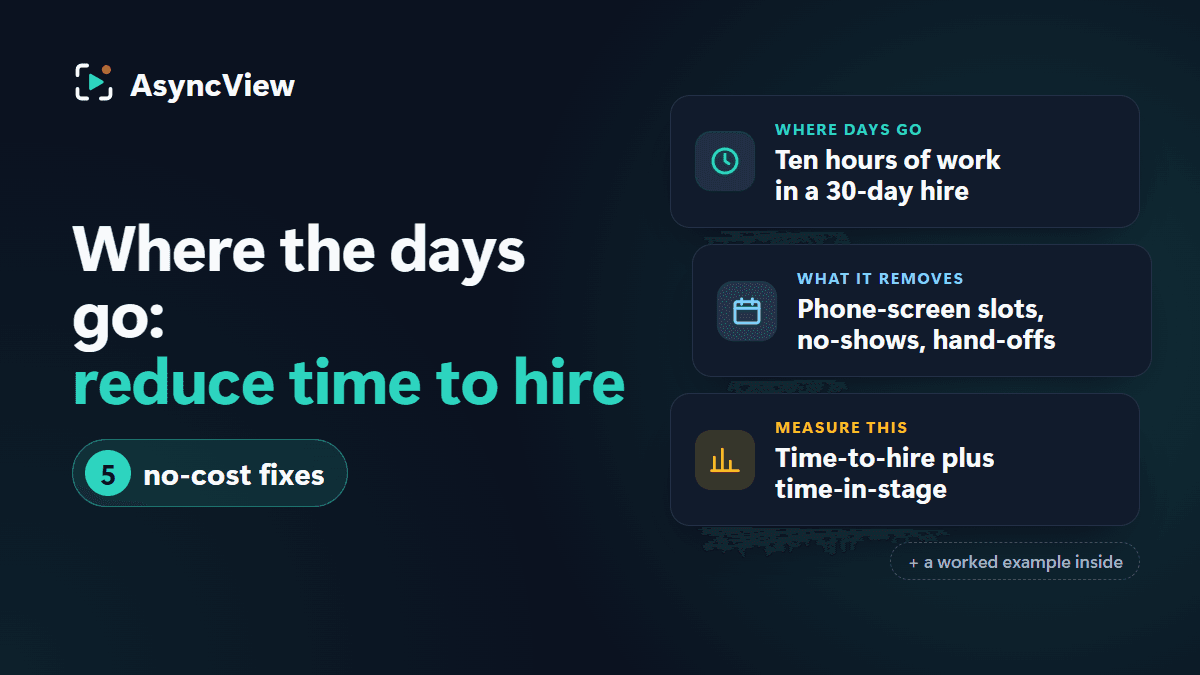
Now add up the actual work. Five hours of phone screens, four hours of manager interviews, an afternoon of CVs and a decision meeting. Call it ten hours of real effort in a 30-day process. Everything else is waiting: for applications, for a slot that suits two people, for the manager's diary to clear, for the meeting where everyone can finally compare notes.
That's good news. You can't make a good interview much shorter, but waiting is overhead, and overhead can go.
Which delays a one-way video interview removes
A one-way video interview replaces the phone screen. Candidates get a few days to record answers to three to five questions, and your reviewers press play when it suits them. New to it? There's a full walkthrough of running your first one, so this post sticks to the days. A recorded round removes three kinds of waiting.
Scheduling the phone screen
Those nine days of phone screens are mostly a calendar problem. Ten candidates with jobs, each needing a half hour that also suits you, arranged over three or four emails apiece. With a one-way video interview you send every invite on the same afternoon. Candidates record when it works for them: at lunch, late in the evening, on a phone in the car park before a shift. Set a deadline five days out, let the automatic reminders do the chasing in the final 48 hours, and most answers arrive without you lifting a finger.
No-shows and rebooking
Every missed call costs you the slot and a second round of emails to rebook. A recorded interview has no slot to miss. If someone hasn't recorded by the deadline, that tells you something about their interest. If they ask for more time, you add a week in one click.
Reviewers waiting for each other
With a phone screen, only the person on the call hears the candidate. Everyone else works from notes: a write-up, a hand-off and often a second meeting to decide who goes through. With recorded answers, the manager, the recruiter and a senior team member each watch at 1.5× on their own schedule, give each answer a star rating, leave a private note and add a recommendation. Everyone's view of a candidate appears on one screen, and the "who should we meet" meeting shrinks to ten minutes on the two people you disagree about. The features page shows the review screen.
Which delays it doesn't touch
A one-way video interview changes one stage of the process. It does nothing for:
Slow decisions. If the panel takes a week to agree after the final interview, no screening tool has an opinion about that.
Too many rounds. Five interviews for a junior role is still five interviews, however quick the first one is.
Offer approval. A salary sign-off that passes through three people in two countries takes as long as it takes.
Posting and sourcing. Applications arrive when they arrive.
If your bottleneck is one of those, fix it first. Otherwise you'll reduce time to hire at the quick end of the process and leave the slow end alone.
A worked example of the days saved
This is an example, not a benchmark. Take the 30-day timeline above and swap the phone screen for a recorded round. Everything else stays the same.
Days 1 to 9: posting and CV screen, unchanged.
Day 9, same afternoon: paste in the ten names and emails and send the invites, with a deadline on day 14.
Days 10 to 14: candidates record. Most answers land in the last two days, after the reminders.
Days 14 to 15: review. Ten candidates, four questions, about ten minutes of answers each. At 1.5× that's just over an hour per reviewer, in one sitting. The manager watches too, so no write-up and no hand-off.
Day 15: shortlist four and send the invitations for live interviews.
Days 16 to 22: manager interviews, same seven days as before.
Days 23 to 25: decision, unchanged.
Days 26 to 27: offer, unchanged.
Twenty-seven days instead of thirty. Three days saved, all from the screening stage, plus about four hours of the recruiter's week handed back. Set a four-day deadline over a weekend (when a lot of people actually record), start watching as answers come in, and it's closer to five.
Three to five days off a 30-day hire, from changing one stage, is what you should expect. Anyone promising to halve your time-to-hire with a screening tool is counting days that were never in the screening stage. To reduce time to hire by more than that, combine it with the changes further down.
Time-to-hire, time-to-fill and time-in-stage: which one to measure
These get used interchangeably. They shouldn't.
Time-to-fill runs from the day the role is approved (or posted) to the day the offer is accepted. It includes sourcing, so it measures the whole business, not just the recruiting team.
Time-to-hire runs from the day the successful candidate enters your process to the day they accept. It measures how fast you move once the right person is actually in front of you.
Time-in-stage is how long candidates sit in each step: in screening, waiting for a manager interview, waiting for an offer.
Use time-to-hire as your headline number, because it's the one your process controls. But time-in-stage is the one that tells you what to fix, so track both. A time-to-hire of 30 days means nothing on its own. Thirty days with twelve of them spent "waiting for the panel to debrief" is a to-do list. And don't average across very different roles: a sales executive and a backend engineer have nothing in common, and a blended number hides both.
Five more ways to reduce time to hire that cost nothing
None of these need a tool. They need someone to decide they're the rule.
Decide within 48 hours of the last interview. Book the debrief when you book the final interview, so it's already in everyone's diary. Memories fade, and the candidate is talking to other companies while you hunt for a slot.
Agree the scoring line before the round. For each question, jot down the two or three things a good answer should contain, before anyone presses play. Reviewers go faster when they know what they're looking for (a simple scorecard does the job), and the hour-long "so what did we all think" conversation mostly disappears. It's fairer too.
Batch reviews into sittings. Block 90 minutes and watch ten candidates in a row, rather than one between meetings for two weeks. Your standard stays steadier and the stage finishes in a day.
Reuse a saved question set. Writing questions from scratch is where the first day of a hire quietly goes. Write them once, save the set, import it next time. The question bank is a decent starting point.
Fewer rounds for junior roles. A recorded screen and one live interview with the manager is enough for most entry-level hires. Every extra round adds a week of diary-juggling and loses candidates to teams that moved quicker.
The limits: speed isn't the goal
A quick bad hire is the slowest outcome there is. You pay for the recruitment, the onboarding, the under-performance and then the whole process over. The reason to reduce time to hire is to remove waiting that adds nothing, not to shave minutes off the parts that tell you who to hire. Where rushing hurts:
Cutting the live round. Don't. The recorded round only decides who gets a conversation. The candidate still needs to meet their future manager, and has questions of their own.
24-hour deadlines. People have jobs, shifts and children. A very short window selects for whoever happens to be free that day, and free is not a skill.
Senior and specialist roles. Experienced people expect a conversation early, and some will walk away from a recorded screen.
Watching so fast you judge the polish. At 2× you'll notice lighting, background and accent before you notice the content. If that's happening, slow down.
Skipping the replies to save time. Telling unsuccessful candidates is part of the process, not an extra. Silence costs you the next hire's applicants.
Frequently asked questions
Does faster hiring mean worse hires?
Not if the time you cut is waiting. Scheduling, no-shows and hand-offs produce no evidence about the candidate, so removing them loses nothing. Speed only hurts when you cut the parts that do produce evidence, like the live interview or a sensible deadline.
How much time can one-way video interviews save?
Three to five days on a 30-day hire, as in the example above, plus several hours of the recruiter's week. Bigger savings come from fixing decisions, rounds and offer approval, which a screening tool can't do for you.
What is a good time-to-hire?
There's no universal number, and anyone quoting one hasn't seen your roles. The better question is whether each stage is as short as the work inside it. Compare against your own last six hires for similar roles, and look at the longest stage first.
How do I measure time-to-hire?
Note the date the successful candidate applied and the date they accepted, plus the days spent in each stage between. A spreadsheet is fine. Use the median rather than the mean, so one hire that stalled for a quarter doesn't hide the rest.
Before changing anything, time your last three hires stage by stage and see where the days really went. If screening is one of the long stages, invite yourself to a four-question interview and answer it. By the time you've finished, you'll know whether it can reduce time to hire for your next role.