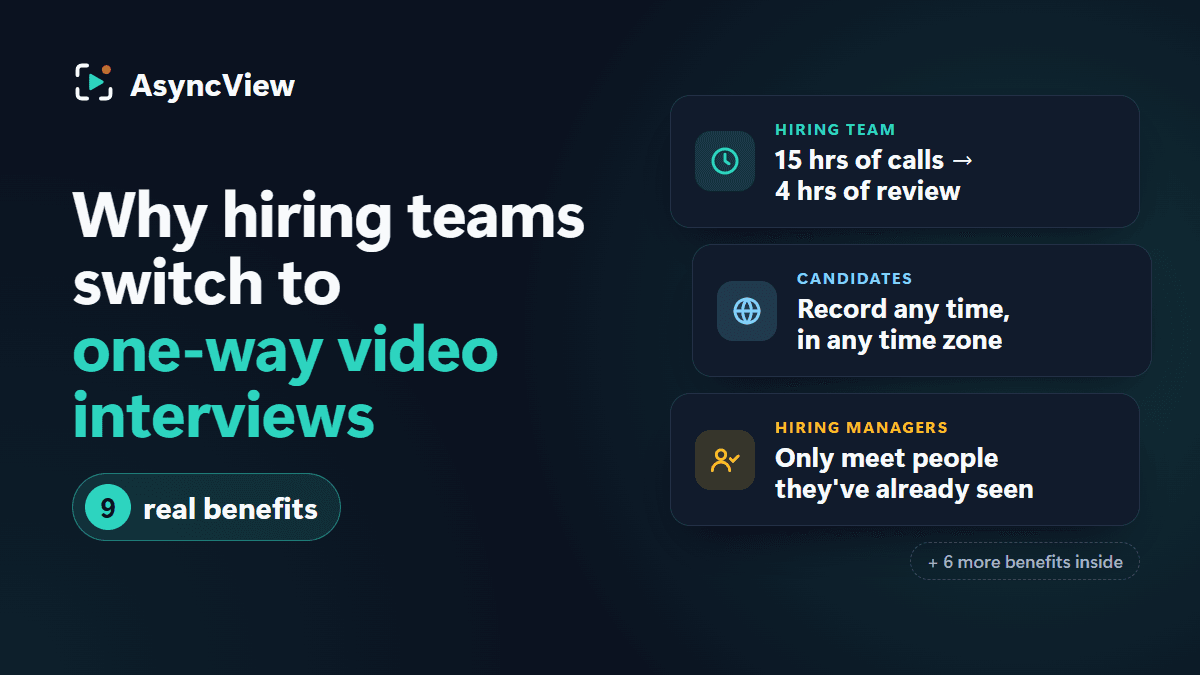
Why hiring teams switch to one-way video interviews: 9 real benefits
Swapping screening calls for recorded answers saves more than calendar time. What changes for your team, your candidates and your hiring managers, with rough numbers for a typical round.
Ask a recruiter what the worst part of a first round is and they'll rarely say the interviews. They'll talk about the calendar: the back-and-forth to find a slot, the candidate stuck in a meeting, the no-show at half past four on a Friday, and the twenty-minute call that was decided in the first two minutes. A one-way video interview fixes all of that in one go.
One-way video interviews take the calendar out of the round. You set the questions once, each candidate records their answers when it suits them, and your team watches when it suits you. If the idea is new to you, our how it works page shows the whole process from both sides.
This article covers the real one-way video interview benefits: what actually changes for the people hiring, for candidates and for the managers who make the final call. We've also been honest about when those benefits don't show up, because disappointing rollouts tend to fail for the same few reasons.
What you get, in one minute
Your team gets hours back, and reviews happen in blocks you choose, not in calendar slots.
Scheduling stops being a job, and a no-show no longer wastes anyone's time.
Every candidate gets the same questions, in the same order, with the same time to answer.
More people get a real look instead of being cut on their CV alone.
Several people can rate the same answer without booking a meeting.
You have a recording to go back to when two candidates are close.
Candidates can answer around their current job, their family and their time zone.
Candidates know exactly what's coming before they start.
Hiring managers only meet people they've already seen and liked.
One-way video interview benefits for the hiring team
1. You get hours back, and you choose when to spend them
Here's a rough sum for a typical round. Say 30 applicants pass your CV screen. A 20-minute phone screen, plus about 10 minutes of booking, rescheduling and writing notes, is half an hour per person. That's 15 hours, spread across two weeks of other people's diaries.
Now send those 30 people four questions with a two-minute limit each. That's at most eight minutes of video per candidate, and most answers run a little short. Watched at 1.5× speed, with a minute or two to rate, it comes to roughly seven or eight minutes a candidate, or about four hours for the whole round. And you can do it in three focused sittings instead of thirty interruptions.
Your numbers will be different, but the pattern holds: each candidate costs you less time, and that time no longer depends on anyone else's calendar. In AsyncView you can play answers from 0.5× to 2× and move between questions with the arrow keys, so a review session moves quickly. If you want to put a figure on those hours, there's a worked cost-per-hire example, and the time-to-hire post shows how many days it takes off a typical hire.
2. Scheduling stops being a job
No more "does Thursday at three work?" You send the link on Monday with a deadline, and the answers arrive through the week. Reminder emails go out automatically 48 and 24 hours before the deadline, so you're not chasing people by hand.
A candidate who never starts costs you nothing, because you never blocked out a slot for them. And if a strong candidate asks for more time, you can extend their deadline by seven days in one click. For most roles, a week is a sensible deadline: long enough to fit around a job, short enough that people don't forget.
3. Every candidate gets the same interview
Phone screens drift. The nine o'clock call gets a fresher interviewer than the five o'clock one. A chatty candidate gets ten extra minutes. Someone forgets to ask the question about notice periods.
A one-way interview doesn't drift. Everyone answers the same questions, in the same order, with the same time limit. That's a structured interview, and structured interviews are widely regarded as fairer and better at predicting job performance than free-flowing chats. The reason is simple: when everyone faces the same test, you compare people with each other instead of with how the conversation happened to go.
4. More people get a real look
When every screen costs half an hour, teams cut hard at the CV stage. That's where good people get lost: the career changer, the graduate without any big names on their CV, the support agent who writes a plain CV but is brilliant with customers.
When hearing from someone costs a few minutes instead of half an hour, you can afford to invite the maybes. Some of them will surprise you.
5. Your team can weigh in without another meeting
Getting a hiring manager and a team lead on the same screening call is hard. Getting them to watch the same recording this week is easy.
In AsyncView, each reviewer rates every answer from one to five stars, gives an overall recommendation (Strong yes, Yes, Maybe or No) and can leave private notes for the team. Everyone's feedback then sits side by side. Agree that each person rates before reading the others, and the first opinion voiced won't quietly become everyone's. You can see the review screen on our features page.
6. You have a record to go back to
Two candidates are neck and neck, and nobody can remember exactly what either of them said about handling an angry customer. With a phone screen, you're relying on memory and a scribbled note. With a recording, you watch the answer to question three again and decide.
It helps when someone joins the process late, too. A new reviewer can watch the shortlist without anyone having to brief them.
Benefits for candidates
A process candidates dislike will cost you candidates, so this side matters just as much. Done well, a one-way interview is often easier for a candidate than a phone call, not harder.
7. They can answer around their life
The people you most want to hire usually have a job already. A one-way interview means they don't have to invent a dentist appointment to take your call. They can record at nine in the evening once the kids are in bed, or on a Saturday morning with a coffee.
Time zones stop mattering as well. A candidate in Manila and a candidate in Manchester get exactly the same interview, each at a sensible hour. If you hire remotely, that alone can be reason enough to switch.
8. They know exactly what's coming
Much of the stress of a video interview is not knowing what will happen. A good one-way interview removes most of that. In AsyncView, a candidate opens a private link from their email, with no account and no app to install, and sees the job title, how many questions there are, roughly how long it will take and when the link closes.
Before anything is recorded, they check their camera, microphone and connection, then answer a practice question that is never recorded or shared. Each real question starts with a five-second countdown, and the timer warns them at 30 and 10 seconds. If the page reloads, they pick up where they left off, and a confirmation email arrives as soon as they submit.
Mention the practice question in the note you add to the interview, which candidates read on the start page before they begin. Candidates who know they can warm up before anything counts start the real questions far less nervous.
Benefits for hiring managers
9. They only meet people they've already seen
By the time a candidate reaches a live interview, the manager has already watched them answer real questions and read the team's notes. Nobody spends the first fifteen minutes on "so, tell me about yourself".
The live hour can go on what a recording can't do: follow-up questions, digging into examples and selling the role to someone you want. A recording finds the people worth talking to, and the conversation decides the hire.
When you won't see these benefits
One-way interviews aren't magic. These are the mistakes that most often cancel the benefits out:
Too many questions. Ten questions at three minutes each is a 30-minute performance. Fewer people finish, and you have more to watch. Three to five questions of one to three minutes is plenty for a first round. Give simple questions one minute and harder, story-style questions two or three.
No idea what a good answer looks like. If reviewers rate on gut feel, you lose the consistency that made the format fair. Write one line per question describing a strong answer before anyone presses play.
Silence on both sides. Tell candidates why you use recorded answers and when they'll hear back, then actually get back to them. Recording answers and hearing nothing is the main reason candidates dislike the format.
Using it where a conversation is the point. Senior and specialist hires expect to talk to someone, and you'll learn more by talking to them.
Treating it as the whole process. It replaces the screening call, not the final conversation. Keep a live round at the end.
How to get these benefits in your first round
Pick one role with a steady flow of applicants, where the first round is mostly about motivation and communication. Customer support, sales and coordinator roles are good places to start.
Write three to five questions. Mix motivation, experience and one situational question. For example: "Why does this role appeal to you?", "Tell us about a time you handled a difficult customer" and "What would you do if two urgent tasks landed at once?"
Add a short note to the interview, which candidates see on the start page: what the role is, why you're using recorded answers, and that they can check their set-up and practise first.
Set a deadline about a week away. Reminders take care of themselves.
Agree what a strong answer looks like before you watch the first one.
Send the link to yourself first, so you've seen the interview from the candidate's side before anyone else does.
For a fuller walkthrough, with an example interview you can copy, read our step-by-step guide to running a one-way video interview. You can also see every step, from both sides, on our how it works page, or browse the full list of features.
Frequently asked questions
Are one-way video interviews worth it for a small team?
Yes, and arguably more so. In a small team, whoever runs the screening calls usually has a full-time job besides hiring. Moving even ten screening calls into a couple of review sessions frees up a meaningful part of their week.
Do candidates dislike one-way video interviews?
Some do, mostly when the interview is long, unexplained or followed by silence. A short set of questions, a clear note, a practice question and a reply at the end make the biggest difference to how candidates feel about it.
How many questions should a one-way interview have?
For a first round, three to five questions of one to three minutes each. That keeps the whole interview to about 15 minutes of recording or less, which is long enough to learn something and short enough that people finish.
Do one-way interviews replace phone screens completely?
For most roles they replace the scheduled screening call. They don't replace the live conversation later in the process, where the candidate meets the manager, asks their own questions and decides whether they want the job.
Are they unfair to people who are nervous on camera?
Some people do find a camera harder than a conversation, so it's worth planning for. A practice question, clear instructions and a reasonable time limit help a great deal. When you review, rate what people say, not how polished the video looks. In AsyncView every candidate gets one take per answer, so nobody gets an advantage by re-recording until it's perfect.
The quickest way to judge whether one-way interviews suit your team is to try one. Create an interview with your own questions, send it to yourself and a colleague, and see how it feels from both sides.