One-way interview questions: 40 examples sorted by what you want to learn
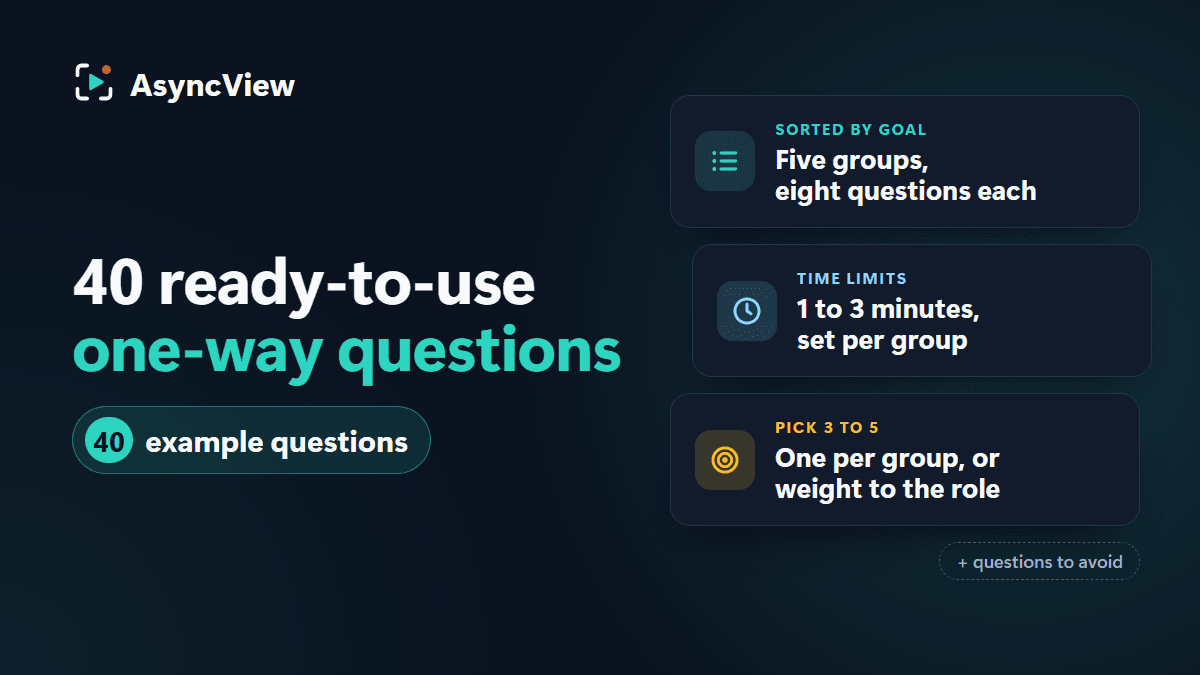
40 one-way interview questions sorted into five groups, with a time limit and a strong-answer line for each, plus how to pick three to five for your role and which questions to leave out.
The hardest part of setting up a one-way video interview isn't choosing a tool. It's the empty box labelled "Question 1". Most people type in what they'd ask on a phone screen, but one-way interview questions have to work without anyone there to say "go on" or "can you give me an example?"
Below are 40 of them, sorted by what each group tells you about a candidate, with a time limit per group and a line on what to listen for. You'll only use three to five.
How one-way interview questions differ from live ones
Live, a follow-up rescues a weak question. In a one-way video interview there is no follow-up. The candidate reads the question, gets a five-second countdown, records an answer and moves on. Anything you didn't ask for, you don't get.
So each question has three jobs to do by itself:
Stand alone. Put the instruction in the question. "Tell us about a time you missed a deadline" gets a story. Add "What did you do once you knew?" and you get the part that matters.
Work in a single take. In AsyncView every answer is recorded once, on purpose, so the round is the same for everyone. That suits "how would you approach this?" and rules out anything that needs notes.
Ask one thing. "Tell us about your last job, what you'd change about it and where you want to be in five years" is three questions fighting over one timer.
Treat the time limits below as ceilings, not targets.
40 one-way interview questions, sorted by what you want to learn
A first round should establish five things: do they want this job, can they explain themselves, what have they done, how do they think when things go wrong, and how do they work day to day.
1. Motivation and fit for this role and company
Limit: 1 minute. Listen for: reasons tied to this job and this company, not an ambition that fits any advert.
What's one thing in the job advert that made you apply rather than scroll past?
What did you find out about our company before applying, and what did you make of it?
Which part of this job do you expect to enjoy least, and why are you applying anyway?
What would need to be true about this job for you to still be here in two years?
Describe the kind of team you do your best work in. How would you check whether we're that team?
What do you want to get better at in your next role?
Thinking about your last job: what would you keep, and what would you happily leave behind?
If you got this job and a friend asked "why that one?", what would you tell them?
2. Communication and clarity
Limit: 2 minutes. Listen for: a shape you can follow, plain words, and an ending that arrives before the timer does.
Explain something you know well, from work or outside it, to someone who has never heard of it.
Describe the last project you worked on as if you were telling a new colleague on their first day.
Tell us about delivering news someone didn't want to hear. How did you word it?
Pick a process from your current or last job and explain it in three steps.
Think of a message you've had to write more than once. What did you change the second time, and why?
Tell us about a time a misunderstanding at work caused a problem. What would you say differently now?
Describe getting a point across to someone who didn't share your expertise. What did you leave out?
Give us your honest view of a tool or system you've used at work: what's good about it and what isn't.
3. Relevant experience
Limit: 2 minutes. Listen for: a real example, the candidate's own part in it, and an outcome that includes what didn't go to plan.
Tell us about a piece of work from the last year you're proud of. What was your part in it, specifically?
Tell us about a time you made a mistake that affected someone else. What did you do next?
Tell us about a time you had to learn a new tool or system quickly. How did you get up to speed?
Tell us about a decision your manager made that you thought was wrong, and what you said.
Tell us about a time you delivered something under a tight deadline. What did you cut, and what did you refuse to cut?
Tell us about a time you spotted a problem before anyone else did. What happened next?
Tell us about a time you worked closely with someone whose style was very different from yours.
Tell us about a time you took on something outside your job description. Why, and how did it go?
4. Judgement and situational
Limit: 2 to 3 minutes. Listen for: a sensible first move, an eye on the trade-off, and the sense to ask rather than guess.
You're halfway through a task and realise the brief is wrong. Whoever wrote it is away until tomorrow. What do you do?
Two colleagues ask for your help at the same time, and both say theirs is urgent. How do you decide?
You notice a colleague's error in something that's already gone out to a customer. What do you do in the next hour?
You've been given a deadline you think is unrealistic. What would you say, and to whom?
Someone asks you a question you don't know the answer to. What do you say in the moment, and what do you do afterwards?
You've finished your work for the day and your queue is empty. What do you do with the next two hours?
Your manager asks you to do something you think is a bad idea, though not a wrong one. How do you handle it?
You're new, and you've found a process everyone follows that seems pointless. What's your first move?
5. Working habits
Limit: 1 minute. Listen for: a method they actually use rather than an adjective they'd like to be known by.
Walk us through how you plan a typical week. What goes on the list first?
When you work remotely, how do you keep people informed without turning into a status-update machine?
How do you like to receive feedback? Give us an example of some you acted on recently.
What have you taught yourself in the last year, and how did you go about it?
A task is taking twice as long as you estimated. What happens next?
How do you decide when to ask for help and when to keep going on your own?
Describe your ideal working day: where you are, when you start and how you break it up.
What's one habit that makes you better at your job, and how did you build it?
How to pick three to five for a role
The simple method is one from each group: five questions, under ten minutes of recording, roughly what a phone screen covers.
The better method weights the set towards the role. Support or sales: two from communication, one each from motivation and judgement. Mostly solo work: lean on working habits. Junior roles: skip group 3 and double up on judgement (there's a fuller set in our graduate and intern questions).
Either way, decide the bar first: "We'll invite someone to the next stage if…" A question that doesn't help you answer that belongs in the live round. Our playbook for running a one-way video interview covers the rest.
Then save your chosen five as a question set in AsyncView. When the role comes round again the set is one import away, and the whole team works from the same list, which is what makes candidates comparable. The features page shows how question sets and review work.
How to write your own one-way interview questions
Three rules for writing your own:
Start from the job. Take a real situation from a typical week and ask what they'd do in it. "A customer emails at 4:55pm on a Friday with…" beats "how do you handle pressure?"
Say each one aloud. If it sounds like a form, rewrite it the way you'd say it across a desk.
Decide the marking line now, not later. Before anyone presses play, write down in a sentence what you'd expect to hear from a good candidate. It keeps every reviewer's stars meaning the same thing. More in reducing bias in one-way video interviews.
Questions to avoid
Brainteasers. "How many golf balls fit in a bus?" finds the people who've practised brainteasers.
"Sell me this pen." It rewards performance, not the job, and it's odd to do alone to a camera.
Anything near a protected characteristic. Health, age, religion, where someone is from, whether they have children, and the sideways versions ("when did you finish school?"). In many countries it's unlawful to base a decision on these, and they're irrelevant anyway. If you're unsure where the line sits, check with an employment adviser.
Stacked questions. Three things with one timer gets you three thin answers. Split them or drop two.
What a one-way round can't tell you
A recorded first round is good at motivation, clarity and judgement. It's poor at three things, so save them for the live rounds:
Negotiation and persuasion. Nobody is pushing back, so you can't see how someone handles it.
Chemistry with the team. Whether a person and a manager will get on runs both ways. Don't judge it from one side.
Deep technical skill. Two minutes to camera shows whether someone can explain a technical idea, not whether they can do the work. Use a practical exercise for that.
The one-way round is a filter, not the decision. Its job is to make sure whoever reaches the live interview deserves the hour. One-way vs live sets the two side by side.
Frequently asked questions
How many questions does a one-way interview need?
Three to five. Fewer than three can't cover motivation, experience and judgement; more than five feels like an exam.
How long should candidates get per question?
One minute for motivation and working habits, two for communication and stories from past jobs, two to three for situational questions. AsyncView sets limits in whole minutes, up to five per question. In AsyncView the timer warns with 30 seconds left and again at 10, so nobody is cut off by surprise.
Can I ask technical questions in a one-way interview?
Yes, if they're about explaining or reasoning rather than performing. "Explain what a database index does to a non-technical colleague" works. "Write a function that…" doesn't, because the candidate has no notes and a single take.
Should every candidate get the same questions?
Yes, for the same role. The same one-way interview questions, the same time limits and an agreed marking line are what make the comparison fair. A saved question set makes that automatic.
Can candidates see the questions in advance?
In AsyncView, no. Before they begin they see the job title, how many questions there are and roughly how long it takes, and a practice question that's never recorded lets them warm up. The real questions appear one at a time. Our tips for candidates are worth linking in the invitation.
Pick your three to five, write the marking line for each, then send the interview to your own inbox. Answering your own questions on camera is the fastest way to find the badly worded one.